Four habits to maximise your ROI on AI investment - Matthew Certner, (IBM) - INDUSTRY 2025

Business transformation is hard. So hard, in fact, that 84% of efforts reportedly fail. Why? Because too many organisations don’t know where to focus, how to scale, or how to identify the path to measurable value. In an era of tightening budgets and resource constraints, finding and executing the right product ideas has never been more critical.
In this INDUSTRY 2025 Spotlight session, Matthew Certner, Head of Digital Product Engineering and Design for IBM Consulting, delivered a message on four habits to lead product transformations successfully.
Why do Most Business Transformations Fail?
Matthew opened by challenging attendees to reflect on projects that consumed months of effort, only to be met with low adoption or no ROI. It’s a common challenge for product teams: products launched without understanding user needs or with too much confidence in assumptions over evidence. The remedy? Focus, feedback, and flexibility.
Generative AI: A Double-Edged Sword
Matthew shared findings from a recent IBM Institute for Business Value study that surveyed 1,000 product engineering leaders. Despite the widespread excitement around generative AI, one in five teams still doesn’t use it across any stage of the product lifecycle.
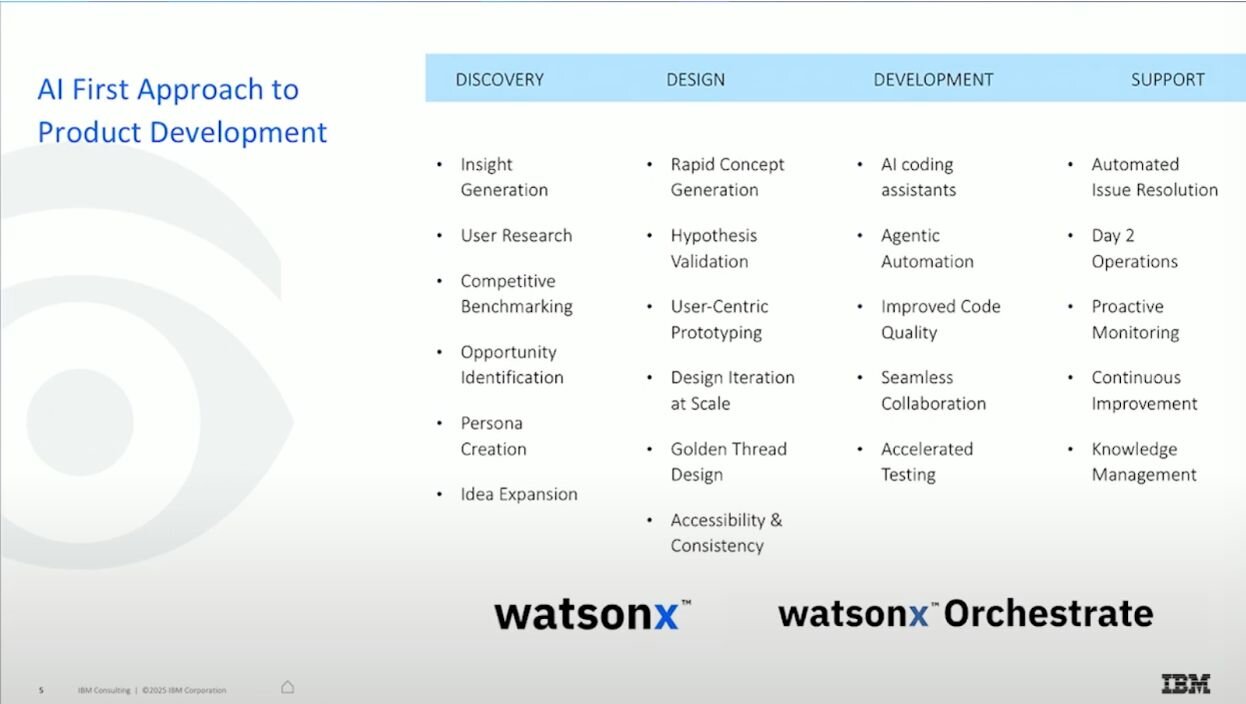
Done right, an AI First Approach to Product Development can compress timelines and cut costs.
What is holding companies back from scaling generative AI? Many companies moving too fast or too slow are missing the mark. Just 27% of teams using GenAI feel it’s delivering on its functional benefits, and only 23% see the financial returns they expected, Matthew cited.
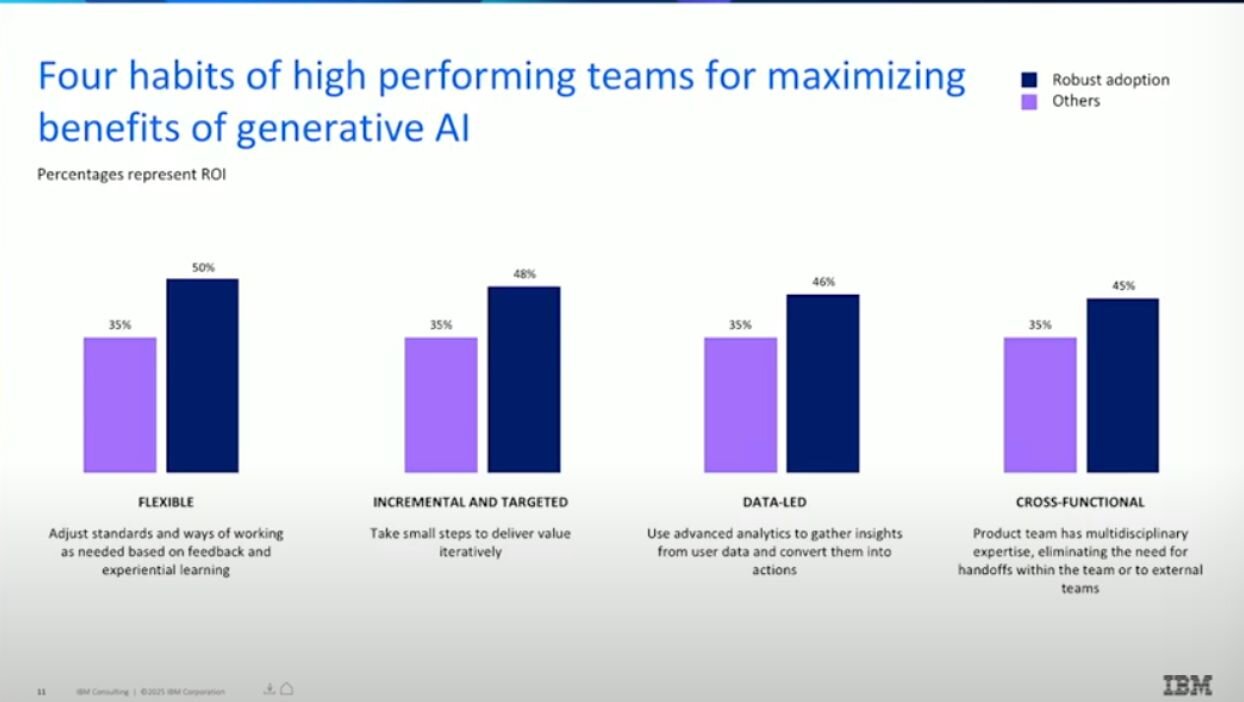
Mathew stressed that there is a great ROI on AI investment, citing that top performers were seeing 60% ROI on AI, compared to the Median of 36%. Maximising ROI comes down to four key behaviours, Matthew explained.
Four Habits That Define High-Performing Product Teams
- Flexibility: High-performing teams are based on feedback. They update their strategies to reflect user needs and product insights. This is especially critical when working with AI models that evolve over time.
- Incremental and Targeted Delivery: The best teams break work into bite-sized chunks, push into production quickly, and use real-world feedback to guide iteration.
- Data-Led: “Very rarely can you build a product on gut instinct alone,” Matthew said. Intuition has a place, but the “HIPPO” effect (highest-paid person’s opinion) remains a real risk. The best teams use quantifiable data to prioritise their backlog, validate hypotheses, and guide strategy.
- Cross-Functional: Product managers, strategists, designers, developers, marketers, working side by side, move faster due to fewer handoffs and more alignment. These teams are structured for speed and built for outcomes.
When teams apply all four behaviours across the product lifecycle. “The return will show,” Matthew said.
The Clock Is Ticking
Matthew reminded the audience of the scale of what’s coming. By the end of 2026, analysts expect that 600 to 800 million new products will be launched. Most of these will fail, Matthew highlighted, but for those who get it right, the opportunity is enormous, and the competition will only get harder. He reiterated that we must push ourselves to experiment, build the right product, and make it successful.
Enter Value Orchestration
Matthew introduced the concept of value orchestration, a continuous, embedded process in product development that aligns delivery with measurable outcomes by tracking and optimising real value creation.
“Simply put, if you’re going to build a product, you need to have some process in place to prioritise the features that will generate the highest return,” he noted.
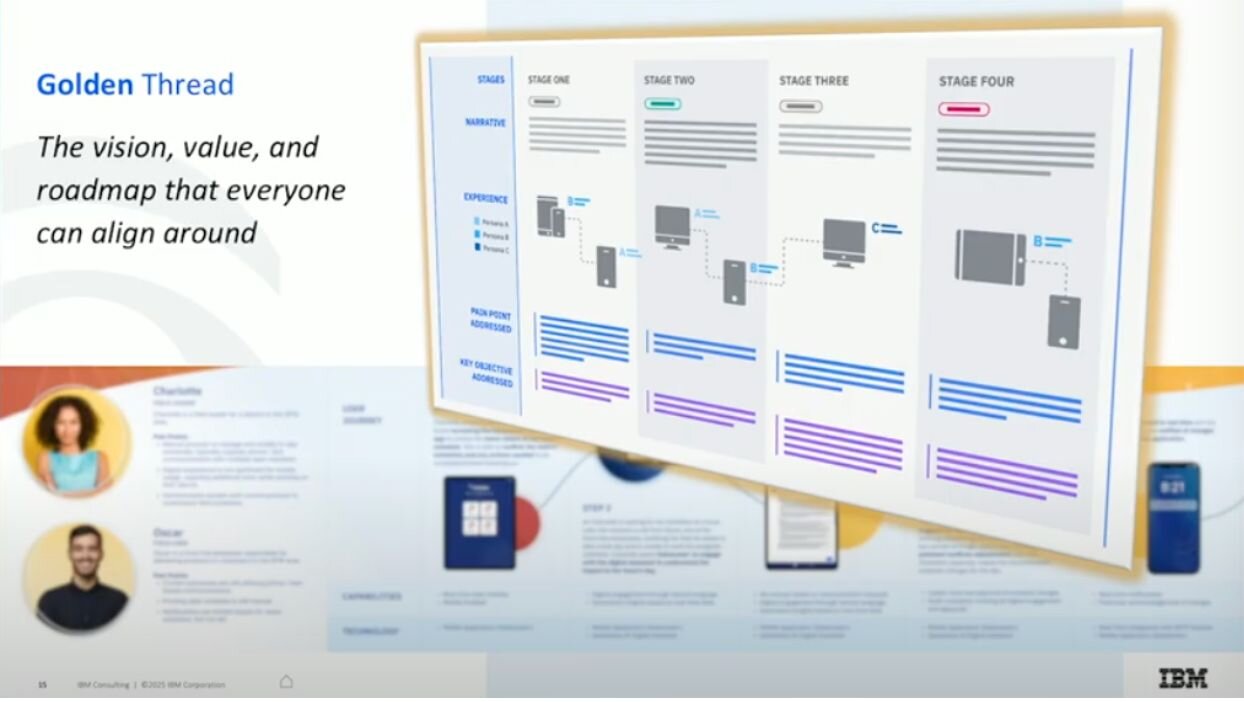
One tool to do this that Matthew highlighted was IBMs “Golden Thread” a layered visual of product features mapped to ROI, technical dependencies, and built-in feedback loops. It’s designed to help teams debate less and align more.
Final Words
Matthew closed with four key takeaways:
- Everyone is now in the product business. There is a large opportunity for organisations to improve their ROI.
- Don’t be in the 20% of teams still ignoring GenAI.
- Technology alone is not enough - successful value orchestration must be done alongside the right team makeup to maximise ROI
- The four habits Matthew mentioned can increase the ROI on AI investment. Flexibility, Incremental and targeted approaches, Data-led decision making, and Cross-functional team cohesion.

About the author
Louron Pratt
Louron serves as the Editor at Mind the Product, bringing nearly a decade of experience in editorial positions across business and technology publications. For any editorial inquiries, you can connect with him on LinkedIn or Twitter.