Why team alignment starts with incentives: Org design lessons from B2B SaaS
The quarterly planning session was a success. Everyone agreed on the big bets, nodded through the roadmap slides, and even shared a couple of laughs over pastries. For a moment, it felt like the team was finally rowing in the same direction.Fast forward three weeks, and the cracks are showing. Sales has committed to a feature that was never on the roadmap. Customer Success, eager to secure a critical renewal, has assured an enterprise customer that every piece of their feedback will be acted on. Engineering is knee-deep in unplanned work. Product is holding the line to protect priorities, and now being painted as “unhelpful” for pushing back.
This isn’t bad communication. It’s not “lack of buy-in.” It’s not because you didn’t put enough sticky notes on the wall.
It’s because your incentives are pointing in different directions.
It’s not personal
One of the biggest traps in product organisations is treating team tension like a relationship problem. “If only we could get Sales and Product to talk more, everything would click.” But the uncomfortable truth is, everyone’s already acting rationally, just not toward the same definition of success.
Sales is measured against quota and commissions, so they’re incentivised to close deals quickly, even if that means promising features that don’t exist yet. Customer Success wants every customer to be happy, so they push for rapid fixes and feature requests, even when they don’t align with strategic priorities. Product is measured on roadmap delivery or OKRs, so they defend the plan to avoid endless scope creep. Engineering is measured on stability and velocity, so they avoid sudden changes that could derail sprints or introduce bugs.
Individually, these goals make perfect sense. Together, they create a constant tug-of-war. Sales wins when they sell big and fast, and Customer Success wins when churn drops, but both can pile pressure onto Product and Engineering. Product wins when they protect the roadmap, but that can slow the pace of new contracts and renewals. Engineering wins when they keep things stable, but that stability can come at the expense of responding quickly to urgent prospect and customer needs.
This isn’t dysfunction. It’s siloed systems doing exactly what they’re designed to do.
How to realign without blowing up your org chart
You don’t have to change everything to fix this. But you do need to make it a unified system so everyone wins together.
Make metrics a team sport
Instead of measuring each function in isolation, create shared success metrics. For example:
- Net Revenue Retention (NRR) ties Product to customer value and Customer Success to retention.
- Feature adoption means Sales won’t just sell features, they’ll help ensure customers actually use them.
- Time-to-value pushes Engineering to enable quick customer wins without sacrificing quality.
This way, “success” stops being a zero-sum game.
Write the rules for changing the plan
Big customers will ask for exceptions. Pretending otherwise is wishful thinking. The danger is that saying yes on the spot might save the deal, but it can also throw the rest of the organisation off balance, derailing Engineering, frustrating Product, and creating false expectations with Customer Success. Instead, set up a clear system:
- Define a clear escalation process for off-roadmap requests from Sales or Customer Success.
- Require visibility on the tradeoffs (e.g., “We can build X for Client Y, but it will delay Feature Z by two weeks”).
- Keep decisions transparent so nobody feels blindsided.
This doesn’t kill flexibility, it keeps flexibility intentional.
Shrink the friction loop
You don’t need to wait for quarterly retros to talk about where incentives clashed. Build in a lightweight, cross-functional review at a cadence that suits you, where you answer a handful of important questions:
- What went well?
- What got blocked?
- Was the block due to conflicting incentives?
Keep it short, keep it honest.
Create small, cross-functional “deal squads”
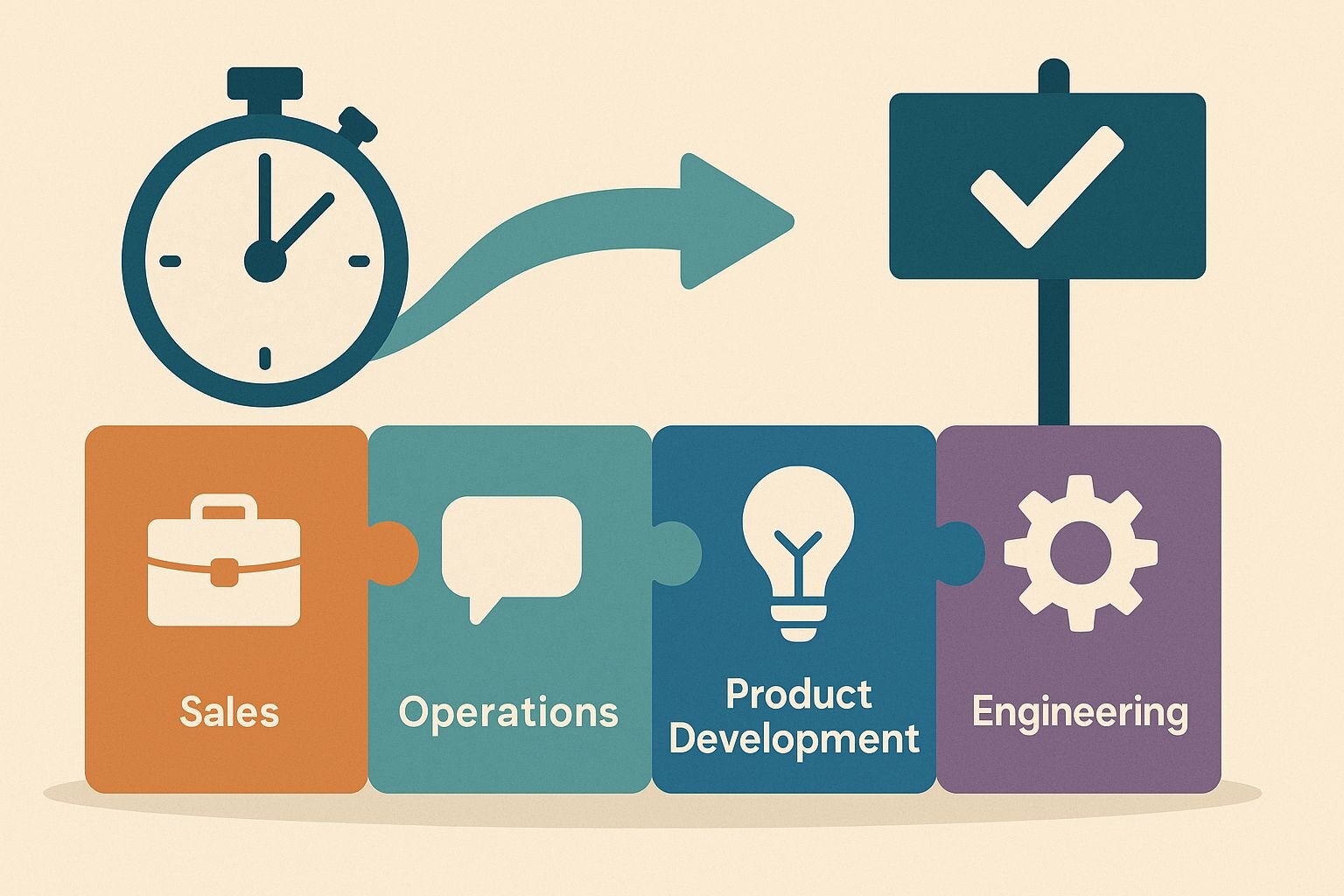
When a high-value opportunity lands, the usual process can slow things to a crawl. Instead of letting it bounce between functions, spin up a temporary squad that can move fast.
- Include one person each from Sales, Customer Success, Product, and Engineering. People with enough authority to make real decisions.
- Give them a clear remit: close the deal while protecting long-term product health.
- Set a short lifespan for the squad so it doesn’t become a permanent distraction.
This way, you balance speed with guardrails and avoid derailing the rest of the organisation.
Run an “incentive stress test” before launching big changes
Every new KPI will change behaviour, sometimes in unexpected ways. Test it before it hits the real world.
- Map how the change would influence decisions in each function.
- Look for where one team’s “win” might create a loss for another.
- Adjust the incentive or add a counterbalance metric to keep everyone moving in the same direction.
A half-hour whiteboard session like this can save months of friction and frustration later.
A real example from startup life
In an earlier role at a B2B startup, we hit this wall early. Sales wanted to close strategic deals fast, even if it meant promising custom work. Customer Success wanted to renew every big customer by saying yes to every piece of feedback. Engineering was buried under scope changes. Product was trying to protect the roadmap, but that made us look like we were slowing growth.
Our solution was to start structuring the company as a data-informed organisation, where every team was accountable for a clear set of metrics and every single person had at least one metric with their name on it. That meant no one could hide behind vague outcomes: success and failure were visible. For Product, the focus was driving measurable business impact from shipped work. For Customer Success, it was net revenue retention. For Engineering, it was deployment stability and bug rates. For Sales, it was revenue from customers who reached defined success milestones within their first six months, so the incentive wasn’t just to win the deal, but to bring in business that would stick and grow.
Once those measures were in place, behaviour shifted. Sales still chased deals, but they focused on customers who were a good fit for our product. Customer Success became more disciplined about what they promised in renewals, prioritising requests that moved the retention and expansion metrics they owned. Engineering became more responsive because their stability targets were tied directly to customer outcomes. And Product finally stopped feeling like the “no police,” because we were all working toward numbers we’d agreed on together, with each team clear on how their success was measured.
It all comes back to incentive
If your teams keep clashing, resist the urge to start with another workshop or alignment session. Those can be useful, but they’re often a bandaid covering a deeper structural wound. The real question is whether the way you measure and reward team members encourages them to pull in the same direction or in completely different ones.
Rather than worrying about alignment, the incentive structure has to come first. The scorecard defines the game. If it rewards collaboration, people will collaborate. If it rewards protecting their own turf, that’s exactly what they’ll do.
Think about it. If Sales is rewarded for closing any deal at any cost and Customer Success defines their success as driving churn as close to zero as possible, both will keep feeding work into the pipeline that doesn’t match the product’s capabilities. If Engineering is measured purely on stability, they’ll push back on urgent changes that could unsettle a release, even when the commercial upside is clear. If Product is judged mainly on sticking to a plan, they’ll see deviation as a threat, not an opportunity. In isolation, each behaviour is logical. Together, they create the kind of friction that feels like dysfunction.
When you start with shared incentives, you don’t need to guess whether teams will work together. You’ve built a system that makes it in their best interest to do so. That’s when the quarterly planning sessions stop being an overly-optimistic show of unity and start becoming an honest snapshot of how the business truly operates. And that is the difference between a team that drifts apart and one that keeps rowing in the same direction long after the pastries are gone.

About the author

Franz Vitulli
Franz Vitulli is a Product Manager at Checkfirst, a B2B AI startup, and an MBA candidate at Birmingham Business School in the UK. He has over a decade of experience building and scaling enterprise platforms, spanning the TICC industry, AI chatbots, digital workplace communication, HRtech & employee experience, publishing and language technology. He regularly offers perspective and analysis about Product and business strategy, SaaS, organisational design and career growth.